Summary
As the urgency to combat climate change intensifies, there is a growing recognition of the need for a robust ledger-based system designed to accurately track methane emissions across supply chains. The aim of such an approach would be to connect carbon emissions with physical products, enabling consumer and customer behaviors to drive meaningful emissions reductions.
Ledger-Based Systems
For instance, the newly established EFI Foundation—supported by leading organizations such as Exxon, RMI, JP Morgan, Toyota, and Oxford University—has released a report on “Integrated Product and Entity Level Carbon Accounting.” The report highlights that international policy developments are accelerating with the European Union’s Carbon Border Adjustment Mechanism (CBAM) being fully implemented in 2026, establishing global benchmarks for measuring product carbon intensity. In response, trading partners, including China, are developing comparable Product Carbon Footprint (PCF) standards to maintain access to EU markets. These shifts underscore the need for a consistent, accounting-based system that ensures fair competition for carbon and methane emissions-differentiated products.
The solution EFI propose is a ledger-based accounting system that tracks emissions across value chains, distinguishing it from the typical accounting-based reporting used for emissions disclosures. This approach enables the development of comprehensive inventories of greenhouse gas (GHG) emissions from upstream suppliers, downstream customers, and ultimate consumers, linking emissions to specific products and activities. Such a system ensures consistency in reporting across supply chains and mitigates the risks of over- or under-reporting emissions.
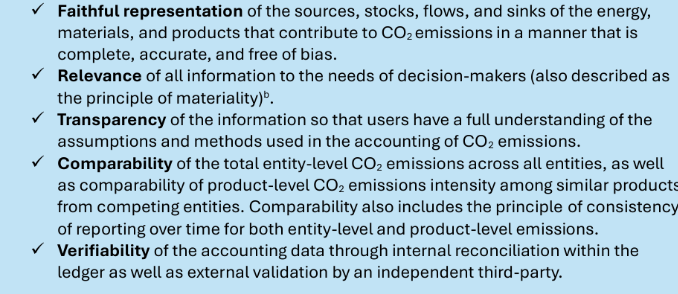
The ledger design proposed is based upon the following 5 principles drawn from widely accepted approaches:
The MiQ Approach
MiQ already operates one of the most established, independently governed ledger-based systems for methane emissions globally. Although not commonly represented as such, the MiQ certification system is a digital ledger-based registry, where operators independently verify and track emissions transfers using certificates. MiQ’s system is operational, and in active use across global energy markets, currently certifying more than 5% of global gas supply, including over 25% of US production. The MiQ scheme:
- Sets / defines a methane emissions management performance standard for operators of natural gas and crude oil along supply chains1, then
- Independent verifiers (auditors) certify actual operator performance of that facility operation using the MiQ standard, and calculate the methane intensity (emissions per processed crude/gas quantities). During an audit, operators are assessed by third party auditors against three pillars, each resulting in a specific score. The lowest of the three scores will determine the final grade on the certificate. The three pillars are:
- Methane Intensity
- Monitoring Technology Deployment
- Company Practices (including LDAR, flaring, venting and other recognised operational methane practices).
- If operators meet the MiQ standard and an independent auditor gives attestation to it, then MiQ issues certificates related to the production from that facility with a specific grade A-F alongside the Methane Intensity achieved.
Following this process, MiQ’s approach creates a dual-sided ledger of carbon and methane emissions stocks, starting with an upstream asset and extending across trade boundaries. The system transparently tracks the flows of carbon and methane into and out of these trade boundaries, providing customers with baseline information on the carbon and methane content of finished products. Today, MiQ certification is independently audited and applied across a growing share of global gas production, demonstrating that ledger-based methane tracking is not theoretical – it is market-proven.
Additional Refinements
The EFI Paper highlights how similar ledger-based accounting principles could be extended to additional applications such as scope 3 emissions tracking and support of global trade in carbon-differentiated products such as the European Union Carbon Border Adjustment Mechanism (EU CBAM) across a range of commodities including cement, iron and steel, aluminium, fertilizer, hydrogen, and electricity.
This includes incorporating engineering fundamentals with mass and energy balance data to provide an internal cross-check of an entity’s processes that converts fuels and materials into products and emissions sources. Using this process, the carbon mass and energy balance identifies all carbon-related flows and stocks, documenting the relationship that the total incoming physical carbon content plus the CO2 emissions attributed to it, minus the direct CO2 emissions within the entity’s production process, equals the total outgoing physical carbon content of products plus the CO2 emissions allocated to these products. The same approach could be used for methane and other emissions products, reinforcing the role of ledger-based systems in enabling credible, comparable emissions tracking across supply chains.