
Introduction
In December 2025, the European Union’s Energy Council and the European Commission walked the tight rope that is European energy and political reality. They acknowledged that energy security of supply is paramount – that failing to move forward with implementation of the EU Methane Regulation (EUMR) wasn’t an option – and that pragmatic solutions were required. The result: the regulation stays, the timelines stay, and compliance responsibilities fall on the companies – European importers – that bring crude oil, natural gas, and coal into the Union.
The EU imports roughly ninety percent of the crude it refines. Its suppliers span every major producing region – the United States, the Gulf states, West Africa, Norway, Latin America – and those producers operate under wildly different methane regimes. Some regulatory regimes, such as in Norway, have measurement and reporting requirements that already approximate the EUMR’s expectations. Others operate in jurisdictions where methane emissions are effectively unmonitored. The EUMR, however, draws no distinction. Every barrel placed on the Union market under a contract concluded or renewed after 4 August 2024 will be required to be accompanied with specified emissions reports.
This paper trail is not optional, and the penalties for failing to produce it are not symbolic. Member States are empowered to impose penalties. The commercial risk is real – and for EU importers, it cannot be transferred back upstream to producers outside the Union’s jurisdiction. In other words, European importers – and those importers alone – are on the regulatory hook.
The crude oil sector’s readiness, however, does not at this point in time match the EUMR’s ambition. In 2024, roughly seven percent of global oil and gas production reached OGMP 2.0 Level 5 – the reporting standard the EUMR treats as equivalent to its own requirements. Current forecasts place it at twenty-six percent by 2027, the year MRV equivalence becomes binding.
This arithmetic is unforgiving: Absent a practical and pragmatic solution, a meaningful share of globally traded crude will not be importable into Europe under compliant terms.
The good news is that a practical solution currently exists and is operational: The MiQ methane performance standard, combined with its Certificate Inter-Regional Import System (CIRIS). Crude oil producers who are certified and importers who use CIRIS are in place to meet the Regulation’s phased obligations on time.
The paper proceeds in three sections. The first sets out what the EUMR actually requires of crude oil imports. The second describes the primary elements of the MiQ crude oil certification standard. The third explains how MiQ certification and CIRIS can be used to meet each of the Regulation’s obligations for crude oil importers and producers.
None of this is a claim that MiQ is the only viable pathway. Other frameworks – OGMP 2.0 (with a formal verification protocol) or other certification systems, along with bespoke producer-level programs (that provide crude oil on a non-commingled basis) – could all play a role. However, for producers and importers who need to act within the Regulation’s deadlines, rather than wait for them, the case for MiQ is straightforward: The program exists; The program is operational; the program grew to market scale in the US; the program is auditable; and, finally, the program is designed for exactly this problem.
1. What the EU Methane Regulation Requires for Crude Oil Imports
The EU Methane Regulation is the EU’s first binding legal instrument that establishes methane emissions rules for oil, gas, and coal – and the first to extend those rules to imports into the European Union. For crude oil, the import provisions are concentrated in Articles 27 through 29 of Regulation (EU) 2024/1787 and come into force in four phases: information reporting, MRV equivalence, methane intensity reporting, and maximum methane intensity. Each has its own deadline. Each places the legal burden directly on the EU importer of record.
1.1 Architecture and Scope
The Regulation entered into force on 4 August 2024 and applies directly to all EU Member States. Its import provisions reach back to the production stage – meaning the ultimate object of the MRV and intensity obligations is the production facility where the crude originated, not the export terminal, refinery, or trading counterparty through which it passes.
A central consequence of this design is an information delivery problem. The legal obligation to document compliance rests with the EU importer, but the operational information required to do so rests with producers that may be located anywhere in the world. The EUMR is silent on how that required emissions information from producer to importer – a problem exacerbated by commingling of supplies and trades made on exchanges. Bridging that gap is the principal implementation challenge the Regulation creates.
1.2 The Phased Timeline
The trigger for most obligations is the conclusion or renewal of a crude oil supply contract on or after 4 August 2024. The table below summarizes the four import-facing deadlines.
| Deadline | Obligation | What the importer must produce |
| May 2025 | Information reporting begins (Art. 27) | Information on each supplier, country of origin, applicable MRV measures, and emissions data as available. |
| 1 January 2027 | MRV equivalence (Art. 28) | Evidence that in-scope contracts cover crude produced under MRV measures equivalent to EU requirements – OGMP 2.0 Level 5 with third-party verification, or direct Article 12 compliance. |
| 5 August 2028 | Methane intensity reporting (Art. 29) | Annual reporting of the methane intensity of production for each in-scope contract. |
| 5 August 2030 | Maximum methane intensity (Art. 29) | For contracts concluded or renewed after this date, demonstration that intensity is below the maximum values set by delegated act; intensity classes also apply. |
Two Commission actions fill the gaps between those milestones. A delegated act due by 5 August 2027 will set the methodology for calculating producer-level methane intensity for crude oil. An assessment report due by 5 August 2029 will evaluate possible maximum intensity values before they are adopted. Neither is an importer obligation; however, both shape the obligations that follow.
The 2027 MRV-equivalence deadline is the first test. By 1 January 2027, an importer holding a contract must demonstrate to a Member State’s competent authority that the producer supplying the crude operates under MRV measures equivalent to the Regulation’s.
1.3 Crude Oil MRV Equivalence and Methane Intensity
The equivalence concept is the pivot around which import compliance turns. Under Article 28, an importer must show that the producer of the imported crude is subject to monitoring, reporting, and verification mechanisms equivalent to those applied to EU operators. Equivalence is not self-declared; it must be documented and capable of being examined by a competent authority.
Two pathways have converged in practice. The first is direct compliance with Article 12, the quantification and reporting regime applied to EU operators, which requires source-level inventories reconciled with site-level measurements and subject to independent verification. The second is participation in the UNEP OGMP 2.0 (Oil and Gas Methane Partnership) framework at Level 5, combined with third-party reasonable assurance verification.
From 5 August 2028, importers must also annually report the methane intensity of production placed on the Union market under each in-scope contract. From 5 August 2030, imports under new or renewed contracts must demonstrate intensity of imported crude below the maximum values set by the Commission.
The practical effect is that unverified imports will face escalating market access friction long before any absolute threshold bites.
1.4 Penalties and Risk Allocation
Enforcement and scope of penalties is delegated to Member States, but the Regulation sets the ceiling. At this point in time, however, they are undetermined in scope. It is important to note that the EUMR does not create an outright ban on non-compliant imports. Instead, it creates a system of financial consequences that make non-compliance potentially untenable for any importer operating at commercial scale.
That design has a specific effect on how risk is allocated. The legal obligation rests with the EU importer. A producer operating outside the Union is not directly subject to the Regulation – however, the importer cannot discharge its obligation without information the producer alone can provide.
The consequence of this is profound: producers who fail to make the required information available will lose access to EU buyers. This is the case not because they are penalized directly but because buying from them becomes commercially unviable for the importer. The legal risk sits downstream; the market risk transcends the supply chain.
Any compliance solution must therefore produce documentation the importer can place in front of a competent authority. It must do so for crude whose production occurred in a jurisdiction the importer does not control. And it must be operational by the 2027 equivalence deadline. With this in mind, the next section examines what the MiQ Standard for Petroleum Operations offers.
2. The Primary Elements of the MiQ Crude Oil Certification Standard
The MiQ Standard is a methane emissions performance certification operated by MiQ, a not-for-profit organization whose stated purpose is to drive methane emissions reductions from oil and gas operations through transparent, emissions-based differentiation. The Standard has been in operation for natural gas since 2021 and currently certifies approximately twenty-five percent of United States natural gas production. In May 2024, MiQ published the MiQ Standard for Methane Emissions Performance for Petroleum Operations, extending the framework to crude oil.[1]
2.1 What MiQ Certifies
MiQ certifies facilities, not companies or jurisdictions. Under the Petroleum Standard, a facility is defined as all contiguous onshore oil and natural gas production sites and equipment located in a single geologic basin, field, or subfield under common ownership or operation. The Standard captures production-stage emissions, matching the scope the Regulation applies to imports.
Each certified facility receives an MiQ score – a letter grade rating from A through F – that captures its methane emissions performance over a twelve-month certification period. The grade is recommended by an independent accredited auditor and approved by MiQ. Certificates attach to the facility and to the volumes it produces. Certification is voluntary and is independently audited. These are the characteristics that make MiQ certification viable under the Regulation’s equivalence test.
2.2 MiQ’s Three Certification Pillars
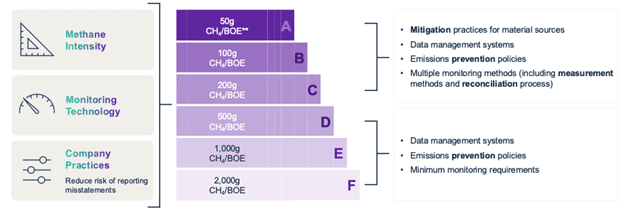
MiQ’s Standard is built on three pillars: Methane intensity; Monitoring technology deployment; Company practices. A facility’s grade is set by its lowest score across the three – a deliberate guardrail against a producer compensating for weakness in one area with strength in another.
Figure: MiQ Performance Standard – Crude Oil
Methane Intensity
The first pillar is a measured methane intensity of crude oil production, expressed in grams of methane per barrel of oil equivalent (g CH4/BOE) of total energy throughput. Total throughput captures both the natural gas and the hydrocarbon liquids produced at the facility – a critical detail for associated gas, co-produced NGLs, and condensate streams. The calculation is grounded in a facility-level inventory of emission sources, reconciled against independent site-level measurements. Grades range from at or below 50 g CH4/BOE (Grade A) to at or below 2000 (Grade F), with thresholds set at 100, 200, 500, and 1000 for Grades B through E.
Monitoring Technology Deployment
The second pillar is the structured deployment of monitoring technology. The Standard distinguishes between facility-scale inspections – wide-area surveys detecting emissions down to the site level – and source-level inspections that directly inspect individual equipment or components. Continuous monitoring systems are recognized where they meet specific autonomous detection and reporting criteria. An equivalent LDAR Program pathway allows operators to substitute alternative monitoring configurations – aerial, satellite, continuous – provided they can demonstrate equivalent probability of detection. The intent of the Standard is to be globally applicable and to concern itself with the outcome, not the technology.
Company Practices
The third pillar is a set of documented methane management policies and procedures – emissions prevention, detection, and abatement programs that the producer must have in place at the facility level and that the auditor verifies. Mandatory practices are required for all grades; additional improved practices are required for Grades A through C. The pillar exists because measured intensity alone can obscure the difference between a facility that is low emission by design, culture, and best practices, and one that happens to be low emissions by luck. Company Practices are the structural evidence that performance is the product of management.
2.3 Verification, Grading, and CIRIS
Central to MiQ’s certification framework is that it is not a self-reporting program. Every facility is audited annually by an independent auditor from MiQ’s recognized auditor (e.g., accredited) list. These auditors operate under published requirements for methane expertise, integrity, and transparency. The auditor prepares an audit report submitted to MiQ for approval. Verification activities consist of annual onsite audits. These are conducted at a reasonable assurance level of verification. This verification architecture is what differentiates MiQ from self-declared emissions programs – and what makes the resulting certificate usable under the EUMR’s equivalence test. The removal of self-reporting, the independence of both MiQ and the auditors from industry and tech providers, and the requirement that the auditor have no financial interest in the outcome of the audit (and certification) are what distinguishes MiQ from many other reporting programs.
Upon approval, MiQ produces digital certificates on a one certificate for each mmbtu produced basis. These certificates are stored in MiQ’s Digital Registry. In addition to containing MRV, location, and emissions information, these certificates can be transacted with the gas or crude oil (i.e., bundled transactions) or separate from the gas (i.e., unbundled transactions.) In this sense, MiQ’s methane performance certificates operate in much the same way as a renewable energy certificate (REC) or guarantee of origin certificate, as well as other energy attribute certificates (EACs)
The certification grade (A-grade through F-) is the signal that the certificate sends to the market. It is deliberately legible – a buyer does not need to parse a fifty-page emissions report to understand what an A-graded facility represents.
MiQ methane performance certificates, on a granular level (1 mmbtu/certificate) provide the required emissions information for EUMR compliance. The emissions information from certificates associated with an LNG cargo being imported into Europe will be combined for the EUMR’s required annual Annex IX emissions report. MiQ has developed rules – the CIRIS (Certificate Inter-Regional Import System) – that sit in conjunction with the MiQ certification framework to provide and allow for MiQ methane performance certificates to be used for EUMR compliance purposes. CIRIS transfers MRV information and environmental attribute certificates across geographic regions, conditioned on proof of physical transport of crude oil imports into Europe.
Both MiQ’s certification framework and CIRIS are operational today. CIRIS, along with elements of the Standard, was designed from the outset to be upgraded as the EUMR’s implementing acts take final shape. Section 3 returns to how it fits each of the obligations.
2.4 Status of the Crude Oil Program
MiQ’s Petroleum Standard – covering methane emissions from crude oil – was finalized in May 2024 and is operational. MiQ completed crude oil certification pilots in 2024 and expects in spring 2026 to announce the certification of a crude oil production facility that is eligible to export crude oil (and certificates) to Europe. The natural gas program, by contrast, has been in operation since 2021 and provides the infrastructure, auditor capacity, and registry operations upon which the crude program now draws. As a result, natural gas certification is more developed in North America than is crude oil methane performance certification. In other words, relatively speaking, there are more natural gas certificates currently available for LNG imports than there are for crude oil certificates. Producers preparing for the 2027 MRV-equivalence deadline should plan with the audit cycle in mind – a producer starting the process in 2026 will be certified within 2-6 months of initiating the process. Crude oil producers (as well as EU crude oil importers) should take this timeline into account for their timeline and planning purposes.
3. Using MiQ Certification for EUMR Compliance
The previous sections set out what the EUMR requires and what MiQ provides. This section addresses the operational question: How can a crude oil producer or an EU importer use MiQ certification to meet each of the EUMR’s obligations, and what should each do to prepare? The short answer: the four phased obligations map cleanly onto the MiQ system, with CIRIS doing the cross-border work.
3.1 Mapping MiQ to the EUMR’s Phases
Under Article 27, crude importers must report information about each supplier, the country where the crude was produced, and the MRV measures applied. An MiQ-certified facility produces exactly this information: identity, methane intensity, audit report, company practices, and monitoring configuration. For crude that is already MiQ-certified, the reporting obligation is substantially discharged by reference to the certificate. For uncertified supply – the majority of the global pool in 2026 – importers will need to gather this information directly and work out how to distribute required information – or become certified.
Article 28’s 1 January 2027 equivalence test is the first binding deadline, and the point at which MiQ’s value is most direct. The Standard’s intensity calculation – a facility-level inventory reconciled with site-level measurements – mirrors the methodological structure that defines OGMP 2.0 Level 5. It is also equivalent to the terms and requirements, as currently provided, in the EUMR. The annual third-party audit provides the verification that OGMP Level 5 reporting alone does not. The resulting certificates (‘summed’ in a EUMR Annex IX emissions report) are legible to a competent authority in a way that unstructured emissions disclosures are not. For an importer seeking to demonstrate equivalence, an MiQ-certified producer is one of the most straightforward options available.
Article 29 imposes two further steps. From 5 August 2028, annual methane intensity reporting begins. From 5 August 2030, imports under new or renewed contracts must demonstrate an intensity below the maximum values set by the Commission, within a class-based framework. MiQ’s grams per CH4/BOE metric, calculated across all emission sources within the facility boundary and reconciled against measurement, provides the core input for Article 29 reporting. Its A- through F-grade translates directly into a position within any threshold-and-class structure the Commission adopts. (For more on MiQ’s methane intensity methodology, see: Johnson et al., 2026. ‘Methane by the Numbers: The Need for Clear and Comparable Methane Intensity Metrics’ in Environmental Science & Technology, 60, 8258-8265)
One caveat is worth flagging. The Commission’s delegated act on intensity calculation methodology is due by 5 August 2027. Any compliance program built today will need to incorporate the final methodology when it is published. MiQ has engaged with the Commission and designed its system for alignment – however, final reconciliation cannot be confirmed until these provisions are adopted.
3.2 How CIRIS Solves the Cross-Border Problem
Each obligation above presumes that MRV data and methane intensity information travel with the physical crude from the producer to the EU importer. In commodity trading, generally – and with natural gas and crude oil, specifically – that presumption cannot be taken for granted. Crude passes through multiple custodians, is commingled with crude from other sources, and is produced under different jurisdictions and accounting conventions. Maintaining a continuous documentary link between the molecule and its methane provenance is a non-trivial operational problem – and in many cases is simply not possible.
CIRIS is designed to solve exactly this problem. It transfers the underlying MRV information and the environmental attribute certificates from the producer region to the import region, conditioned on proof of physical transport. For importers, it reduces the compliance burden to transactional steps – verifying the certificate, matching it to physical transport, and maintaining the record – rather than an open-ended information-gathering exercise. For producers, it provides assurance that the certification they pay for will actually reach the buyer who values it. For competent authorities, it provides a consistent documentary format across suppliers.
In addition to being compliant with EUMR requirements, the CIRIS process maps onto current crude oil trading practices and is relatively low cost. It is also a considerably more affordable process than administering a program that would trace all crude transactions (– and that is assuming that a viable, independent methodology for doing this has even been developed.)
3.3 A Practical Path for Producers and Importers
The cost of early preparation for crude oil producers for EUMR requirements – that is, engaging in the certification process – is the cost of an annual audit, some additional monitoring investment, and the administrative work of contractual integration. The cost of late preparation is the possibility of missing the 2027 equivalence deadline, being unable to supply or source crude under compliant terms and facing the commercial consequences that follow.
For crude oil producers with existing or prospective EU buyers, the practical pathway is direct: engage with MiQ and an accredited auditor in 2026, with a target of a certification within two to six months. Producers already engaging in OGMP 2.0 Level 5 reporting will find most of the underlying data work already done; the additional burden of MiQ certification sits with the audit, the company practices documentation, and the monitoring configuration – not in a rebuild of the emissions inventory. Producers not yet at OGMP Level 5 will need to take the measurement and reconciliation steps MiQ requires, which will also position them for any future direct OGMP engagement.
For EU importers, the practical pathway centers on procurement and contracting. Contracts concluded or renewed on or after 4 August 2024 are already in scope of the EUMR’s equivalence test. Importers who have not yet incorporated MRV equivalence provisions into their supply agreements should do so. Importers can also clear and transact MiQ crude oil certificates on exchanges and trading platforms such as Xpansiv’s CBL Global Spot Exchange for Trumarx’s CG Hub. Importers who have should review them against the specific documentation MiQ andCIRIS provide. Securing MiQ-certified supply, where it is available, is a low-friction way to reduce the 2027 compliance workload. Working with trading counter-parties to adopt CIRIS transfer is a method to reduce the ongoing administrative burden after 2027. Where certified supply is not yet available for a given grade or origin, importers can work with suppliers on a certification roadmap tied to contract renewal dates – building the equivalence evidence over time rather than scrambling to produce it in the final months of 2026.
Conclusion: A Practical Path Forward
The EU Methane Regulation is the EU’s first legal instrument to bind the methane intensity of global crude oil imports to the commercial decisions of European buyers. Its architecture is deliberate: phased obligations, producer-level scope, member state enforcement, and a class-based intensity framework that will make emissions performance a pricing input. The design reflects a coherent theory – that differentiated market signals, backed by verification, drive emissions reductions more efficiently than prescriptive caps alone.
What is not an open question is whether the EUMR will be implemented. The European Council’s December 2025 announcement, along with public statements by European Commission leadership since then, has settled that. Nor is it an open question whether crude oil producers and EU importers need to act.
They do – and they need to begin acting now, not in the final quarter before each pending deadline.
MiQ certification offers a pathway that is aligned with the EUMR’s equivalence benchmarks, extended to crude oil through a published Standard, and supported by cross-border transfer infrastructure in the form of CIRIS. It is not the only potential pathway, but it is operational today. For producers seeking to maintain viable European commercial access after 2027, and for importers seeking to document compliance by then, it is the pathway most fully developed for the specific challenge the EUMR creates.
In addition, given the experience of both U.S. and Canadian producers with natural gas certification, U.S. and Canadian crude oil producers are well-positioned to certify their crude assets. This is especially advantageous given the increased reliance of Europe on North American crude oil exports in recent weeks due to reduced crude oil shipments from Middle East Gulf sources.
The choice facing producers and importers is not whether to prepare for the EUMR – that choice has been made for them. The choice is whether to prepare within a structured, audited, market-recognized framework, or to improvise. The former is available. The latter is a harder road, and with a more doubtful conclusion than it may appear.
The oil sector has done harder things on tighter timelines. This is a solvable problem. Let’s solve it.
[1] Main Document for Onshore Production, version 1.0